
Description
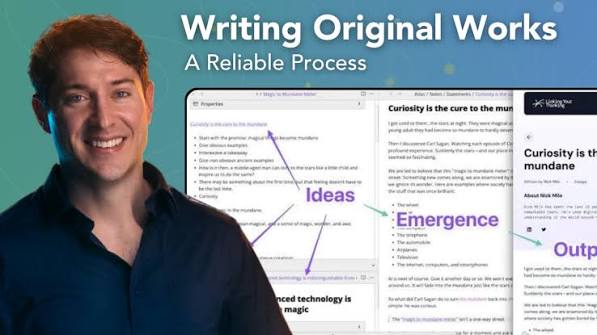
Nick Milo – Writing Original Works: A Complete Guide to Creating Unique and Meaningful Content
Introduction
Writing original works is one of the most valuable creative skills in today’s content-driven world. While information is available everywhere, true originality remains rare. Many writers struggle to move beyond collecting ideas and often find themselves repeating concepts that have already been explored countless times. This is where Nick Milo’s philosophy on writing original works becomes particularly relevant.
Nick Milo is widely recognized for helping creators, writers, thinkers, and knowledge workers transform scattered information into meaningful and original output. His approach emphasizes connecting ideas, developing unique perspectives, and building systems that support long-term creative growth. Rather than simply consuming information, writers are encouraged to actively engage with knowledge and create something that reflects their own experiences, insights, and thinking.
This guide explores the principles behind writing original works, why originality matters, and how creators can develop a sustainable process for producing authentic content that stands out.
Understanding the Meaning of Original Work
Original work is not about inventing something entirely new from nothing. Most ideas are built upon existing knowledge, experiences, observations, and perspectives. The true value of originality lies in combining these elements in a way that creates a fresh viewpoint.
Every writer brings unique experiences, personal observations, professional expertise, and intellectual interests to their work. When these factors are combined thoughtfully, they produce content that cannot be replicated by anyone else.
Original work often includes:
- Personal insights and reflections
- Unique interpretations of existing ideas
- Connections between unrelated concepts
- Practical experiences and lessons learned
- Innovative frameworks and methodologies
- Thoughtful analysis and critical thinking
The goal is not merely to share information but to contribute something meaningful to the broader conversation.
Why Originality Matters More Than Ever
The digital landscape is saturated with articles, videos, podcasts, newsletters, and social media content. Information has become abundant, but genuine insight remains scarce.
Original content offers several advantages:
Builds Authority
People trust creators who provide unique perspectives rather than repeating widely available information. Original work establishes credibility and positions the writer as a thought leader.
Creates Long-Term Value
Content that introduces new ideas or frameworks remains relevant longer than content that simply summarizes existing information.
Attracts Loyal Audiences
Readers return to creators who consistently provide fresh thinking and meaningful insights.
Encourages Deeper Learning
The process of creating original work requires active engagement with ideas, leading to better understanding and retention.
Supports Personal Growth
Writers develop stronger critical thinking abilities when they focus on creating rather than merely consuming information.
The Foundation of Creative Thinking
One of the most important principles in developing original work is understanding that creativity is often the result of connecting ideas.
Many creators mistakenly believe originality appears through sudden inspiration. In reality, original thinking usually emerges from continuous exploration, curiosity, and reflection.
Creative thinkers often:
- Read widely across multiple disciplines
- Capture interesting observations
- Maintain collections of ideas
- Reflect on experiences regularly
- Explore unexpected connections
- Question assumptions
- Experiment with different perspectives
These habits create the conditions necessary for original insights to emerge naturally over time.
Building a Personal Knowledge System
A major aspect of producing original work involves creating a reliable system for managing ideas.
Without a system, valuable insights are easily forgotten. Writers often encounter fascinating concepts but struggle to retrieve them when needed.
An effective knowledge system helps creators:
Capture Information
Interesting ideas can appear at any moment. Recording them immediately ensures they are not lost.
Organize Thoughts
Structured organization allows writers to identify patterns and relationships between concepts.
Connect Ideas
The ability to link information across different topics often leads to original insights.
Develop Concepts
Ideas rarely arrive fully formed. They evolve through continuous refinement and reflection.
Generate Content
A well-maintained knowledge system provides a consistent source of inspiration for future projects.
The goal is not to collect information endlessly but to transform knowledge into creative output.
From Information Consumption to Creation
Many people spend years consuming content without creating anything meaningful. While learning is important, excessive consumption can become a form of procrastination.
The transition from consumer to creator requires a shift in mindset.
Instead of asking:
“What should I learn next?”
Consider asking:
“What can I create from what I already know?”
This simple change encourages active engagement with knowledge rather than passive accumulation.
Creation deepens understanding because it forces writers to:
- Clarify their thinking
- Identify knowledge gaps
- Organize information logically
- Develop original arguments
- Communicate ideas effectively
The act of creating often reveals insights that would never emerge through consumption alone.
Developing a Unique Perspective
One of the defining characteristics of original work is perspective.
Two writers may study the same subject yet produce entirely different content because their experiences shape how they interpret information.
Developing a unique perspective involves:
Drawing from Personal Experience
Real-world experiences provide context that generic information cannot offer.
Challenging Conventional Wisdom
Questioning common assumptions often leads to innovative thinking.
Exploring Interdisciplinary Connections
Many breakthrough ideas occur at the intersection of different fields.
Reflecting Consistently
Regular reflection helps uncover patterns and insights that others may overlook.
Sharing Honest Observations
Authenticity resonates more strongly than attempting to imitate popular voices.
A unique perspective cannot be manufactured. It develops naturally through curiosity, experience, and thoughtful engagement with ideas.
The Role of Idea Connections
Many original works emerge from unexpected connections between concepts.
For example, a writer studying psychology may discover insights applicable to marketing, education, leadership, or product design.
The ability to connect ideas creates opportunities for innovation because it encourages:
- Cross-disciplinary thinking
- Pattern recognition
- Creative problem-solving
- Novel interpretations
- Fresh frameworks
Rather than viewing knowledge as isolated categories, successful creators look for relationships between seemingly unrelated topics.
These connections often become the foundation of original content.
Overcoming Creative Blocks
Every writer encounters periods when creativity feels difficult. Creative blocks are often caused by unrealistic expectations rather than a lack of ability.
Common causes include:
Perfectionism
Waiting for flawless ideas prevents meaningful progress.
Information Overload
Consuming excessive information can overwhelm creative thinking.
Fear of Judgment
Worrying about criticism often inhibits experimentation.
Lack of Clarity
Unclear goals make it difficult to focus creative efforts.
Inconsistent Practice
Creativity strengthens through regular use.
To overcome creative blocks:
- Write regularly
- Focus on small projects
- Explore curiosity-driven topics
- Review previous notes
- Embrace imperfect drafts
- Experiment without pressure
Consistency often produces better results than waiting for inspiration.
Creating Meaningful Content
Originality alone is not enough. Effective work must also provide value.
Meaningful content typically helps readers:
- Solve problems
- Understand complex ideas
- Gain new perspectives
- Improve decision-making
- Develop useful skills
- Think more critically
Writers should focus on serving their audience while maintaining authenticity.
The most impactful work often combines originality with practical usefulness.
Long-Term Creative Development
Creating original work is not a one-time achievement. It is an ongoing process of growth and refinement.
Long-term development involves:
Continuous Learning
Curiosity fuels creative evolution.
Consistent Creation
Regular output strengthens creative skills.
Reflective Practice
Reviewing past work reveals areas for improvement.
Experimentation
Trying new approaches encourages innovation.
Patience
Meaningful originality develops gradually over time.
Writers who commit to these practices build sustainable creative careers and produce increasingly valuable work.
Practical Steps for Writing Original Works
If you want to create more original content, consider implementing the following process:
- Capture ideas daily.
- Maintain organized notes.
- Reflect on what you learn.
- Connect related concepts.
- Develop personal interpretations.
- Write consistently.
- Share your work publicly.
- Gather feedback.
- Refine your thinking.
- Repeat the process continuously.
These habits create a strong foundation for long-term creative success.
Conclusion
Nick Milo’s approach to writing original works emphasizes the transformation of information into insight. Rather than focusing solely on consuming knowledge, creators are encouraged to build systems, connect ideas, develop unique perspectives, and consistently create meaningful content.
Originality is not about discovering completely new ideas. It is about bringing your own experiences, observations, and understanding into the creative process. By cultivating curiosity, organizing knowledge effectively, and practicing deliberate creation, writers can produce work that stands out in an increasingly crowded digital landscape.
The future belongs to creators who move beyond information collection and actively contribute original thinking. Through consistent effort, thoughtful reflection, and a commitment to meaningful creation, anyone can develop the ability to produce truly original works that resonate with audiences and create lasting value.




Reviews
There are no reviews yet.